Zephyr Protocol — Breaking the Chicken and Egg Situation with ZSD Adoption
TL;DR
Focus on Adoption
Since the inception of Zephyr Protocol, our primary focus has been on building a robust, secure, and innovative stablecoin system. However, driving broader adoption of ZSD requires overcoming a "chicken and egg" dilemma: To drive broader adoption of ZSD, we need exchange support and significant use cases. Conversely, exchanges and users are more likely to support and adopt ZSD if there is already substantial circulation and usage.
Taking on USDT
USDT has become the "default currency" in the crypto space, used extensively to move funds between exchanges and as the main quote currency for crypto markets. Despite its widespread adoption, USDT has several drawbacks compared to Zephyr:
- Centralized
- Lacks Transparency
- No Privacy
- High Transaction Cost
USDT does have a first mover advantage. Although Zephyr is better; we need to be creative and innovative to upset the status-quo. With our upcoming v1.2.0 changes and the plan for v2.0.0 in motion for 2024; we aim to make ZSD as attractive as possible…
Upcoming v1.2.0 Changes
The v1.2.0 update aims to enhance the protocol’s functionality and security by reducing fees for minting and redeeming ZSD. This change lowers barriers for entry and increases ZSD circulation, making it easier to provide liquidity and maintain the arbitrage peg on exchanges. These changes are a major step in the drive for adoption, and secures Zephyr's position as technically superior to our competition.
Introducing the ZSD Yield Mechanism (v2.0.0)
To drive ZSD adoption, we propose introducing a yield mechanism similar to ZRS for ZSD! This would provide a strong incentive for users to obtain ZSD via ZEPH purchases, rewarding them for doing so and enhancing ZSD circulation and enticing exchange support.
We propose a ZSD Yield Reserve, allowing users to mint a new “ZSD Stake/Yield” token, redeemable for ZSD plus rewards. Alternatively, “ZSD Minter” tokens could be issued alongside minted ZSD, giving access to the Yield Reserve.
A portion of the block reward will be allocated to the Yield Reserve, perhaps along with capturing small transaction fees to bolster the reserve, while still maintaining extremely competitive fees.
Driving adoption and growth within the Zephyr ecosystem requires innovative solutions and strategic planning. The proposed ZSD Yield Mechanism aims to create a strong incentive for users to engage with the protocol, enhancing its position in the stablecoin market. Our primary goal is to drive adoption of ZSD and ensure the success of Zephyr Protocol!
In-depth Article
The Drive for Adoption
Since the inception of Zephyr Protocol, our primary focus has been on building a robust, secure, and innovative stablecoin system. The Zephyr Stable Dollar (ZSD) and Zephyr Reserve Share (ZRS) have been key components in achieving this goal. However, the journey towards widespread adoption has presented a classic "chicken and egg" dilemma. To drive broader adoption of ZSD, we need exchange support and significant use cases. Conversely, exchanges and users are more likely to support and adopt ZSD if there is already substantial circulation and usage.
With the v1.2.0 hardfork on track for its release date, bringing fee adjustments and Monero updates, our focus now shifts to more drives for adoption. The primary objective of our future v2.0.0 update is to foster adoption from a technical perspective, as this is our most pressing priority.
The Path to Increased Adoption
Upcoming v1.2.0 Changes
The v1.2.0 update is introducing critical changes aimed at enhancing the protocol’s functionality and security. By reducing fees for minting and redeeming ZSD, we lowered the barriers for entry and aimed to increase ZSD circulation. These changes were necessary to create a more inviting environment for new users while maintaining the protocol’s integrity.
ZSD is pegged at $1 within the protocol by its rate in terms of $1 worth of ZEPH. On exchanges, it maintains an arbitrage peg through trading between exchanges and interfacing with the protocol via minting and redeeming ZSD for ZEPH. In the interim, the Zephyr Protocol team will likely need to assist with liquidity for future ZSD listings significantly.
With these changes, providing liquidity and maintaining the arbitrage peg becomes much more practically possible. This is crucial for adoption on exchanges that will look to support ZSD and achieve our long-term vision of capturing market share from USDT.
The Role of Oracle V2
While Oracle V2 is a long-term development goal designed to bring a truly decentralized pricing oracle system into Zephyr Protocol, it does not address the immediate need to drive adoption. Oracle V2 aims to further enhance price data verification, minimize manipulation, and improve security and decentralization. However, our current focus is on creating mechanisms that will immediately boost ZSD adoption.
Oracle V2 is a revolution akin to Zephyr Protocol V1, bringing a Djed stablecoin to a Monero codebase. Its release will likely denote Zephyr Protocol V2.0.0 and, from a technical perspective, take Zephyr to the next level. We have been working hard on the implementation for this change, but the calls for the changes for V1.1 and V1.2 mean that the development on Oracle V2 will take a back seat to these more pressing changes.
Introducing Oracle V2 will be another important driver for ZSD adoption but not as significant as the changes planned in the meantime.
Zephyr is Better
Superior Native Chain Implementation
Zephyr Protocol operates on its native blockchain, providing greater freedom and control to enhance the stablecoin protocol directly. This native chain approach contrasts with other projects that operate as layers on top of existing blockchains, giving us unparalleled freedom and power to make radical and significant changes.
Privacy-Enhanced Transactions
Privacy is a core tenet of the Zephyr Protocol. While maintaining all the fundamental principles of Djed, Zephyr goes a step further by incorporating privacy features inherited from Monero. This ensures hidden transaction destinations and amounts, resulting in a private stablecoin protocol that offers true digital anonymous cash payments.
Decentralization and Security
Zephyr Protocol avoids centralized risks such as poor management, bad actors, and insolvency. By operating as a decentralized protocol, Zephyr aligns with the core ethos of cryptocurrency and DeFi, providing a more secure and trustworthy platform for users.
Strong Reserve Incentives
Zephyr Protocol includes robust mechanisms to incentivize reserve providers. These include transaction fees on minting and redeeming stablecoins and a portion of the block reward allocated to the reserve. This creates a pseudo-staking reward mechanism that benefits reserve providers and ensures the stability of the protocol.
Comparison with USDT
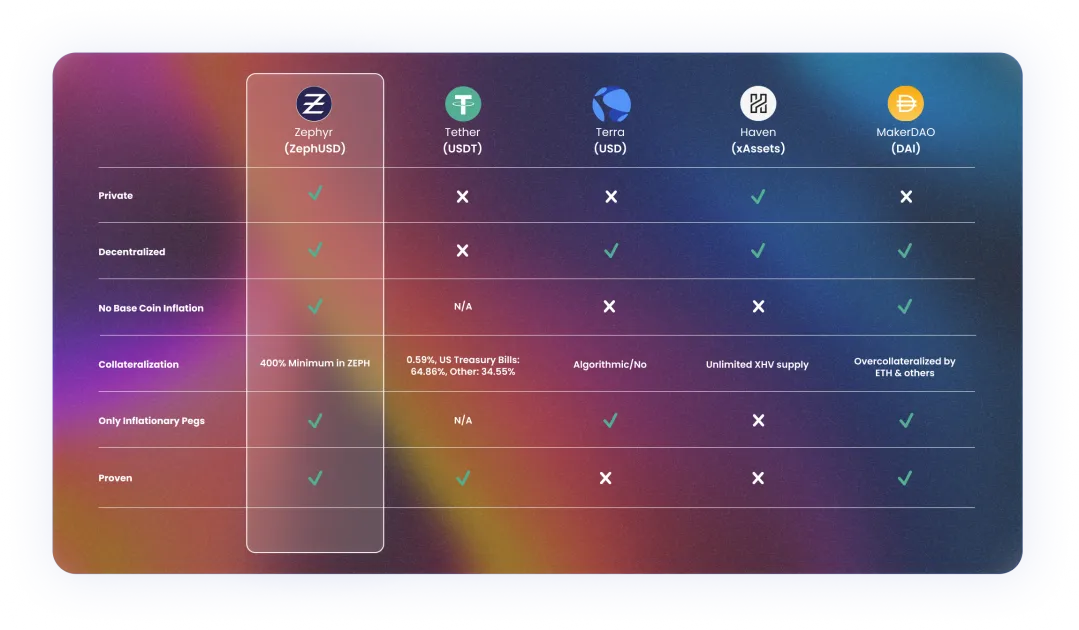
USDT has become the "default currency" in the crypto space, used extensively to move funds between exchanges and as the main quote currency for crypto markets. Despite its widespread adoption, USDT has several drawbacks compared to Zephyr.
USDT is centralized and lacks transparency, exposing users to counterparty risk. It does not offer privacy, and transactions are traceable. Moreover, USDT on Ethereum incurs high gas fees, making transactions expensive during network congestion.
Zephyr, on the other hand, offers decentralization, privacy, and lower transaction fees. Our ultimate goal is to challenge USDT as the preferred means of transferring funds between exchanges first and foremost. As a stepping stone to significant ZSD quote markets, exchanges just supporting ZSD (with a ZSD/USDT market) will enable ZSD to become a viable and attractive alternative for moving funds between exchanges.
With sub-cent transaction fees, ZSD will stand out as a preferred method, especially during periods of high gas prices on Ethereum and Bitcoin.
Comparison with UST (Terra/Luna)
If Zephyr operated on a system like Terra/Luna, the current market conditions and the inadvertent protocol stress test would likely have triggered a death-spiral event. Terra/Luna's design led to hyperinflation and collapse, while Zephyr's over-collateralized model prevents such scenarios.
Zephyr Protocol, based on the Djed model, ensures that the supply of its base coin, ZEPH, is fixed to scheduled emissions via PoW mining only. No ZEPH is ever minted to maintain the peg, safeguarding against hyperinflation and collapse.
MakerDAO
The DAI stablecoin is soft-pegged to the U.S. dollar and is backed by collateralized debt positions (CDPs). This system has proven to be vulnerable in periods of extreme market volatility or blockchain congestion. An example of this is the “Black Thursday” event.
During a significant crash in the ETH price, many Vaults became undercollateralized (below the 150% collateral required). Due to the congestion on the Ethereum network, liquidations were triggered to auction off the ETH from the undercollateralized Vaults. However, the congestion resulted in many auctions being won at $0 bids because other users were unable to place their bids, leading to significant losses for the MakerDAO system.
Once again, if Zephyr was based on CDPs it would not have been able to handle the 50% price crash during the inadvertent protocol stress test and would have resulted in liquidations.
Conclusion
Zephyr Protocol is battle-tested, proven, and superior to its competition. The only technical downside has been the protocol fees for moving in and out of ZSD. Initially, the fees were deemed fair given the privacy, proven implementation, and decentralization Zephyr offers and were in place as added security. However, the practical cost of these fees has hindered adoption.
Taking the required 4% hit for moving in and out of ZSD is expensive. Couple that with the divergence of the spot and moving average prices on both sides of the trade introduces an additional "psudeo fee" as actions use the "worst" price to avoid protocol manipulation. But this can result massive effective fees, minimum of 4% + (difference between the spot and ma)%.
Reducing this minimum to 0.2% with v1.2.0 will make a massive difference and in times of low price volatility will result in small fees.
While there will always be optimal times for conversions due to the dual pricing system, we can also focus on safely adjusting how the moving average is calculated, making it more favorable for users while retaining the anti-protocol manipulation it was designed for.
Will the v1.2.0 changes be enough to achieve our goals? Despite how well Zephyr shapes up; we still face the "chicken and egg" situation with exchange support and need another mechanism to drive the interest into ZEPH -> ZSD that we are trying to garner.
Introducing the ZSD Yield Mechanism
Background
The demand for ZRS is driven by its inbuilt yield/pseudo-staking rewards. To foster similar interest in ZSD, we propose introducing a yield mechanism for ZSD. This could significantly drive interest and adoption within the Zephyr ecosystem by providing a strong incentive for users to obtain ZSD via ZEPH purchases.
Existing stablecoins like USDT have a first-mover advantage. To capture market share from these competitors, increasing ZSD circulation is crucial. Higher ZSD circulation would enhance exposure for ZEPH and incentivize exchanges to support ZSD, as exchange support and ZSD adoption rates are closely tied together.
Initial Challenge
Since wallet balances are unknown in a Monero fork, it’s impractical to reward users based on wallet balances. We need a new innovation akin to the ZRS pseudo-staking rewards to create a similar incentive for ZSD holders.
Concept Stage
We propose introducing a ZSD Yield Reserve, operating similarly to the current reserve. Users could mint a new “ZSD Stake/Yield” token, redeemable for ZSD plus rewards. This token could require a minimum amount of ZSD (e.g., 1k/5k/10k).
Alternatively, we could issue “ZSD Minter” tokens alongside minted ZSD, giving access to the ZSD Yield Reserve. They could be required to redeem on ZSD redemptions. A challenge would be distributing these tokens to existing ZSD holders, which would be essential.
Funding the ZSD Yield Reserve
As Zephyr is PoW-based, we could allocate a portion of the block reward to the ZSD Yield Reserve, similar to the 20% allocation for ZRS. However, this allocation would likely be less than 20% due to the inherent stability of ZSD.
Additionally, introducing small transaction fees could bolster the reserve. Our transaction fees are currently very low, and even with minor increases, they would remain competitive. Increased ZSD transactions would benefit ZSD yielders, driving further adoption and usage.
Conclusion
Driving adoption and growth within the Zephyr ecosystem requires innovative solutions and strategic planning. The proposed ZSD Yield Mechanism aims to create a strong incentive for users to engage with the protocol, ultimately enhancing its position in the stablecoin market.
As we continue to refine and develop this exciting new feature, our primary goal remains clear: to drive adoption of ZSD and ensure the success of Zephyr Protocol. With a working and battle-tested protocol, our focus is now on achieving widespread adoption. This is a crucial step before moving on to more advanced developments like Oracle V2.
We invite our community to stay tuned for further updates and detailed announcements as we progress on this journey. Your continued support and involvement in the Zephyr Protocol are invaluable as we work towards these goals.